Find Your Focus: I Wrote a Book About Street Photography
I have a legitimate published book. I still can't quite believe I'm typing that.
You can officially buy it right here.
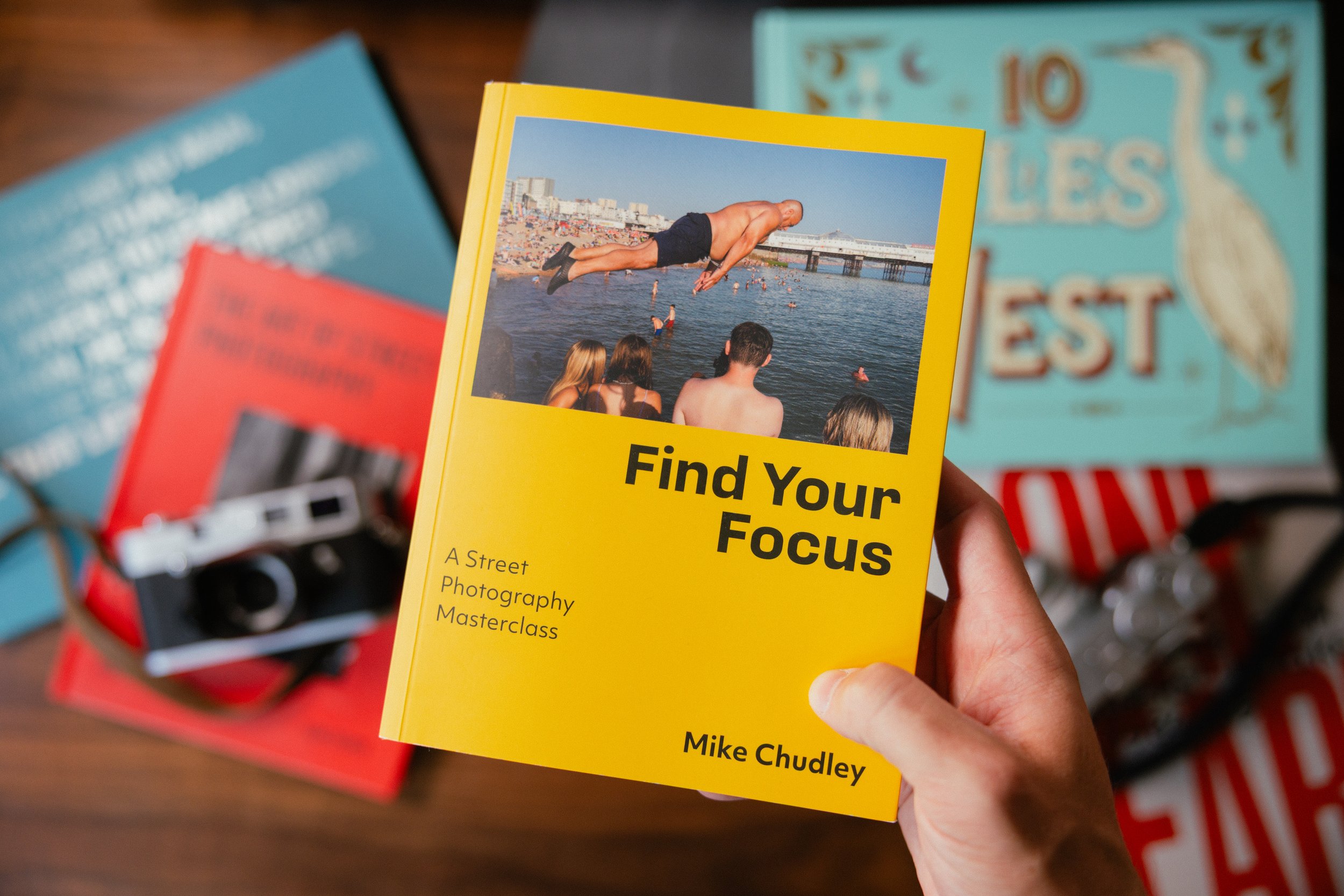
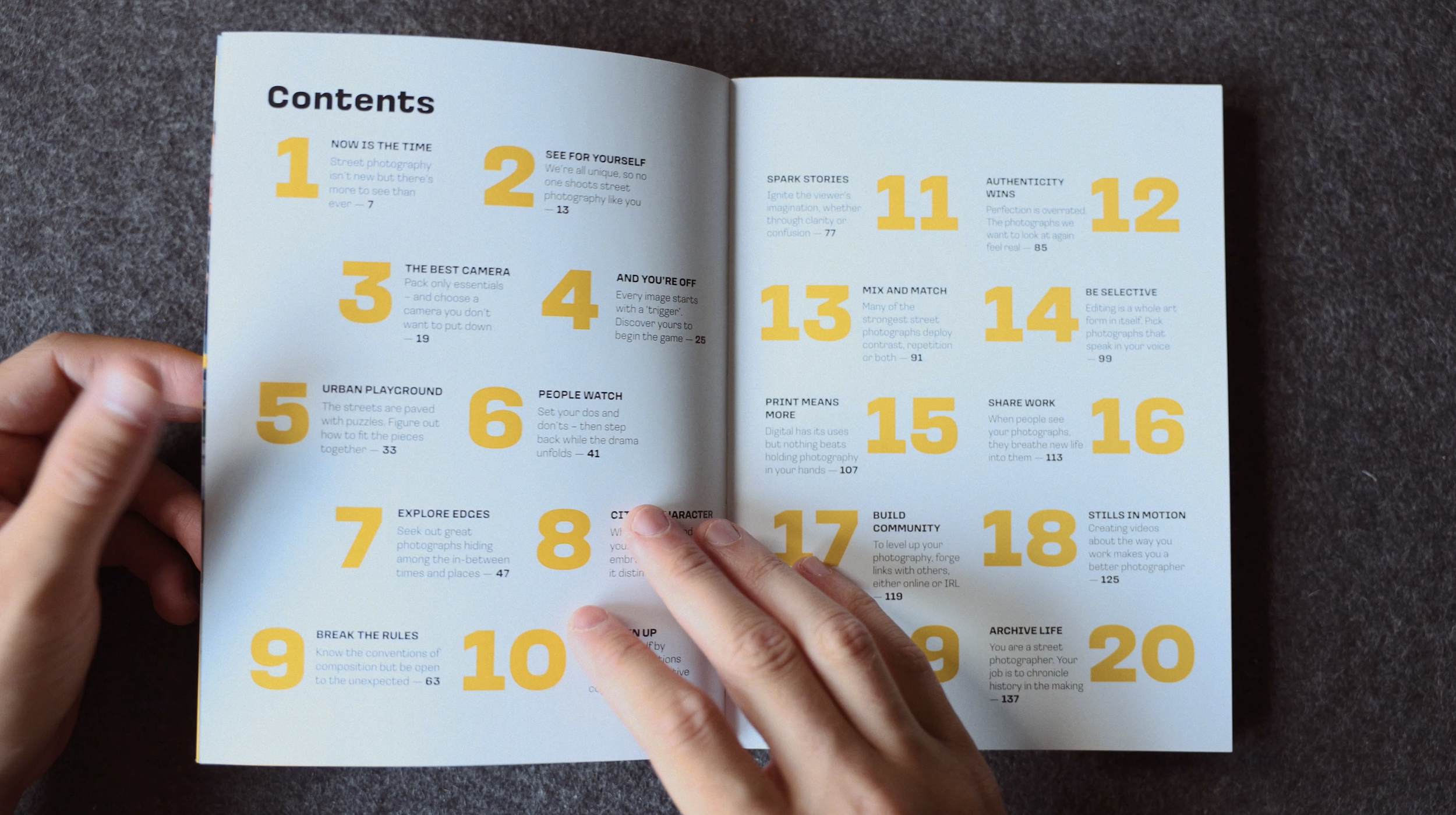
It's called Find Your Focus, it's a street photography masterclass, and very soon you'll be able to walk into a shop, pick it off a shelf and buy it. There are twenty chapters in there, a load of my favourite photographs from over the years, and pretty much everything I think and feel about the world of street photography - the practical stuff, the more conceptual stuff, and all the things going through my head when I'm out on the streets taking pictures.
The whole thing is aimed at helping you get better at street photography, enjoy street photography, or try street photography for the first time.
A conversation with younger me
While I was making this book, the main thing I felt like I was doing was having a conversation with a younger version of myself.
When I think about 19 year old Mike, who'd just left home and moved close to London and started wandering around the city with a camera, he was facing all sorts of creative challenges and problems. The same ones we all face when we pursue anything. And as I started putting this together, I realised that's exactly what the book was becoming - a conversation with that version of me. What problems was I coming up against? What ideas hadn't landed yet? What would have saved me a couple of years of guessing?
If I'd had this book ten years ago, it would have been very helpful. That's the idea behind it.
Rather than reading the whole thing out loud and ruining it for everyone, I want to pull out three ideas from three different chapters, in no particular order, and share a bit more around them.
Chapter 6: People Watch
This is one of my favourites.
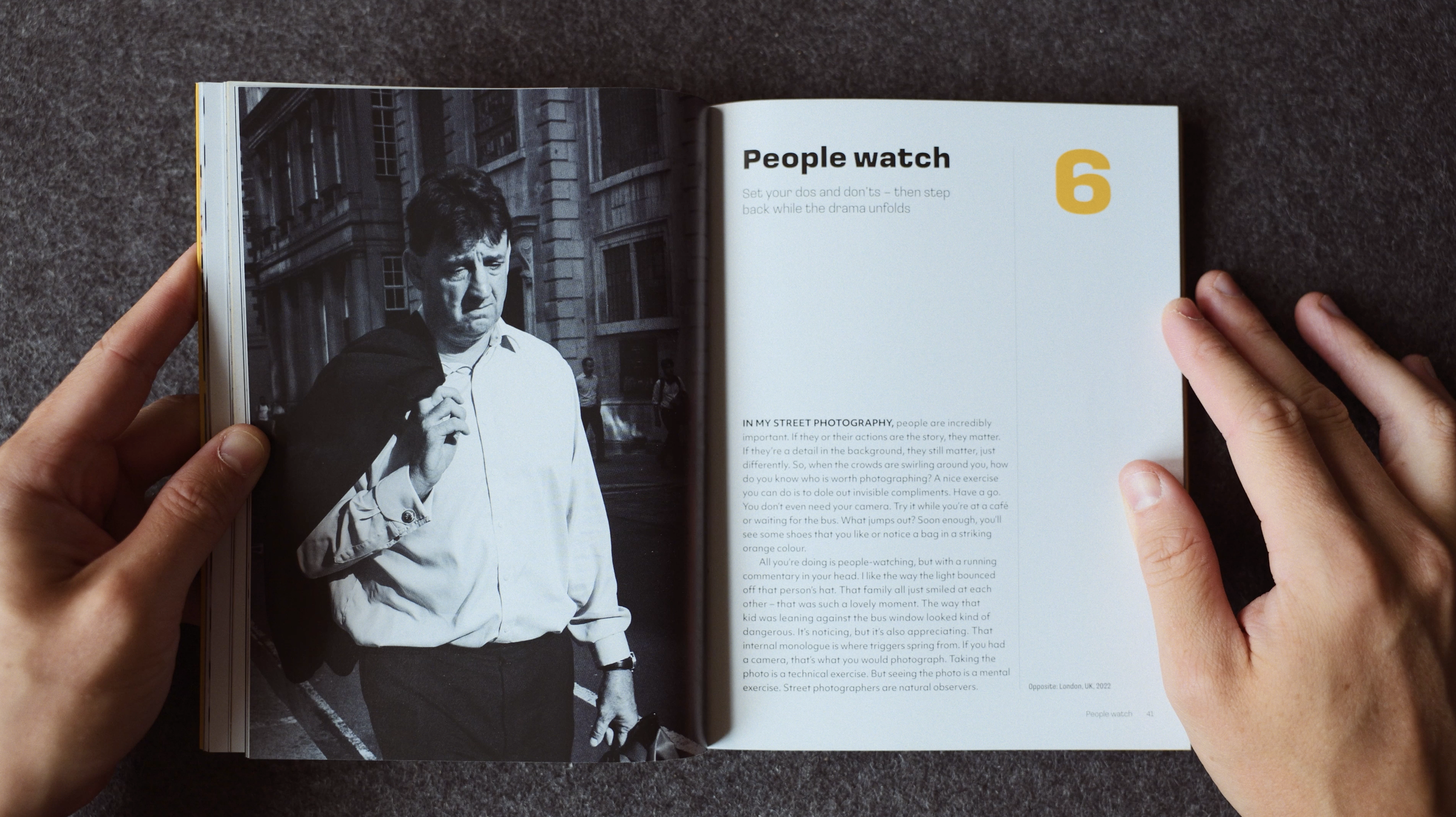
Street photography is just a visual demonstration of people watching. And everybody enjoys people watching. Everybody is a little bit nosy, even the ones who insist they aren't.
There's a side note to this chapter I keep coming back to. There are two things people look at when they see a picture.
The first is contrast, of any kind. The focal point of an image is usually the contrast between light and dark, or between colours, or between shapes. I know that's a broad statement, but if I had to describe what human beings look at when they see art, it's contrast.
The second thing human beings look at is other human beings. More specifically, themselves. It's funny — show a group photo of twenty people to those same twenty people and nobody looks at anybody else. Everyone goes straight to themselves.
So street photography, documentary photography, the history of photography as we know it, is really always about people.
Within this chapter I talk about something I call invisible compliments:
When the crowds are swirling around you, how do you know who is worth photographing? A nice exercise you can do is dole out invisible compliments. Have a go. You don't need a camera. Try it while you're at a café or waiting for the bus. What jumps out at you? Soon enough, you'll see some shoes that you like, or notice a bag in a striking orange colour. All you're doing is people watching, but with a running commentary in your head. I like the way the light bounced off that person's hat. That family all just smiled at each other, that was such a lovely moment. The way that kid was leaning against the bus window looked a little bit sketchy. It's noticing, but it's also appreciating. That internal monologue is where triggers spring from. If you had a camera, that's what you would photograph. Taking the photo is a technical exercise, but seeing the photo is a mental exercise. Street photographers are natural observers.
Further into the chapter, I make the case that certain images become more interesting when a person is anonymous.
There's a lot of commentary around street photography insisting you must see faces, that you must be able to identify what the subject is doing, that the back of someone's head can't make a good photograph. I don't think that holds. Not having access to the full story can create intrigue. If the eyes are covered, that sense of mystery can elevate the shot.
One of the example images in the book is a man asleep on the commute from Manhattan to Staten Island. I was drawn to how the light was falling on him. What an outfit to fall asleep in — the complementary colours of his trousers and top, the hat, all the chains. Taken during golden hour, summer sun setting around 8pm, bathing him in this incredible light. He seems like an interesting character, and you're left with questions about who he is and where he's going. All of it heightened by the fact you can't see his face.
Other times you need the person fully visible for the picture to make any sense at all. There's a shot a few pages later that looks like it could have been taken in the seventies, eighties or nineties, but was actually 2024. Sharp suit, a man who looked like he was on a mission as he crossed the road in front of me. As soon as he stepped onto the pavement, I took it.
Two photographs I like. One where the person is a mystery, one where the face is the whole point. Do what you will with that.
Chapter 9: Break the Rules
Some people might find this one interesting. A few might disagree with me, which is fine.
Everyone has their own idea of what street photography is and isn't, and the conversation about defining it feels like a never-ending discussion online. This chapter is where I put my thoughts on the matter.
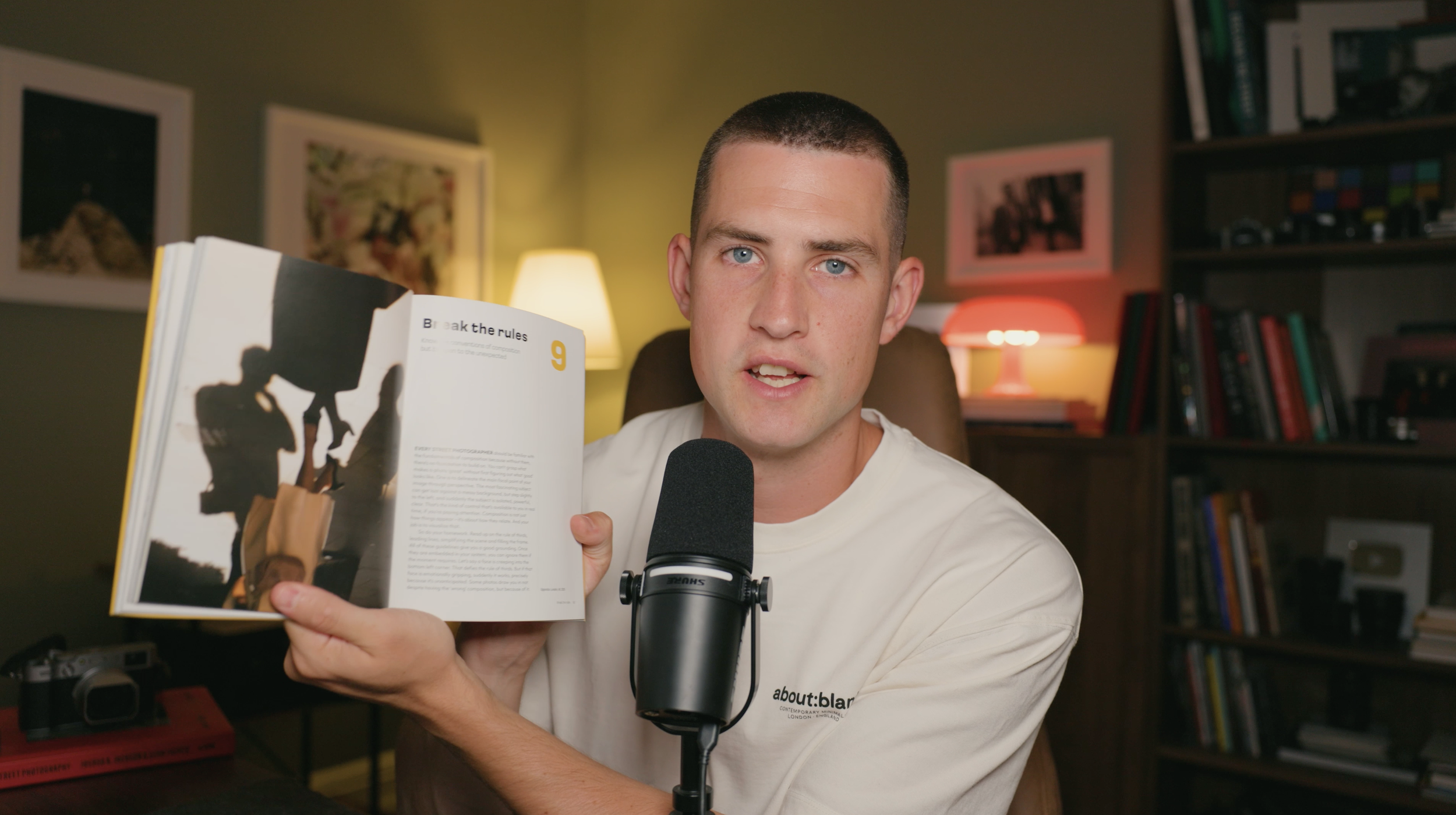
Know the conventions of composition, but be open to the unexpected. Every street photographer should be familiar with the fundamentals of composition, because without them there's no foundation to build on. You can't grasp what makes a great photograph without first figuring out what a good one looks like. The most fascinating subject can get lost against a messy background. But step slightly to the left and suddenly the subject is isolated, powerful and clear. That's the kind of control that's available to you in real time, if you're paying attention. Composition is not just about how things appear. It's about how they relate, and your job is to visualise that.
So do your homework. Read up on the rule of thirds, leading lines, simplifying the scene, filling the frame. All of it gives you a good grounding. Once those things are embedded in your system, you can ignore them when the moment requires it.
Say a face is creeping into the bottom left corner. That defies the rule of thirds. But if that face is emotionally gripping, it suddenly works precisely because it's unanticipated. Some photographs draw you in not despite the wrong composition, but because of it.
The same applies to cliches. There are street photography cliches, and you can lean into them if they make you happy and excited to go out and shoot. Everybody knows what a silhouette looks like — but nobody has seen the one you're photographing at that moment. That's the difference.
We're told that the greatest compositions bring harmony and balance. Not every image succeeds the same way. The rules are different for every scene you look at, and knowing what the rule of thirds is doesn't mean applying it will make your picture better. At some point, judgement and taste have to come from you.
Chapter 13: Mix and Match
This is probably the most practical chapter in the book, and it's a game I'm always playing when I'm out shooting.
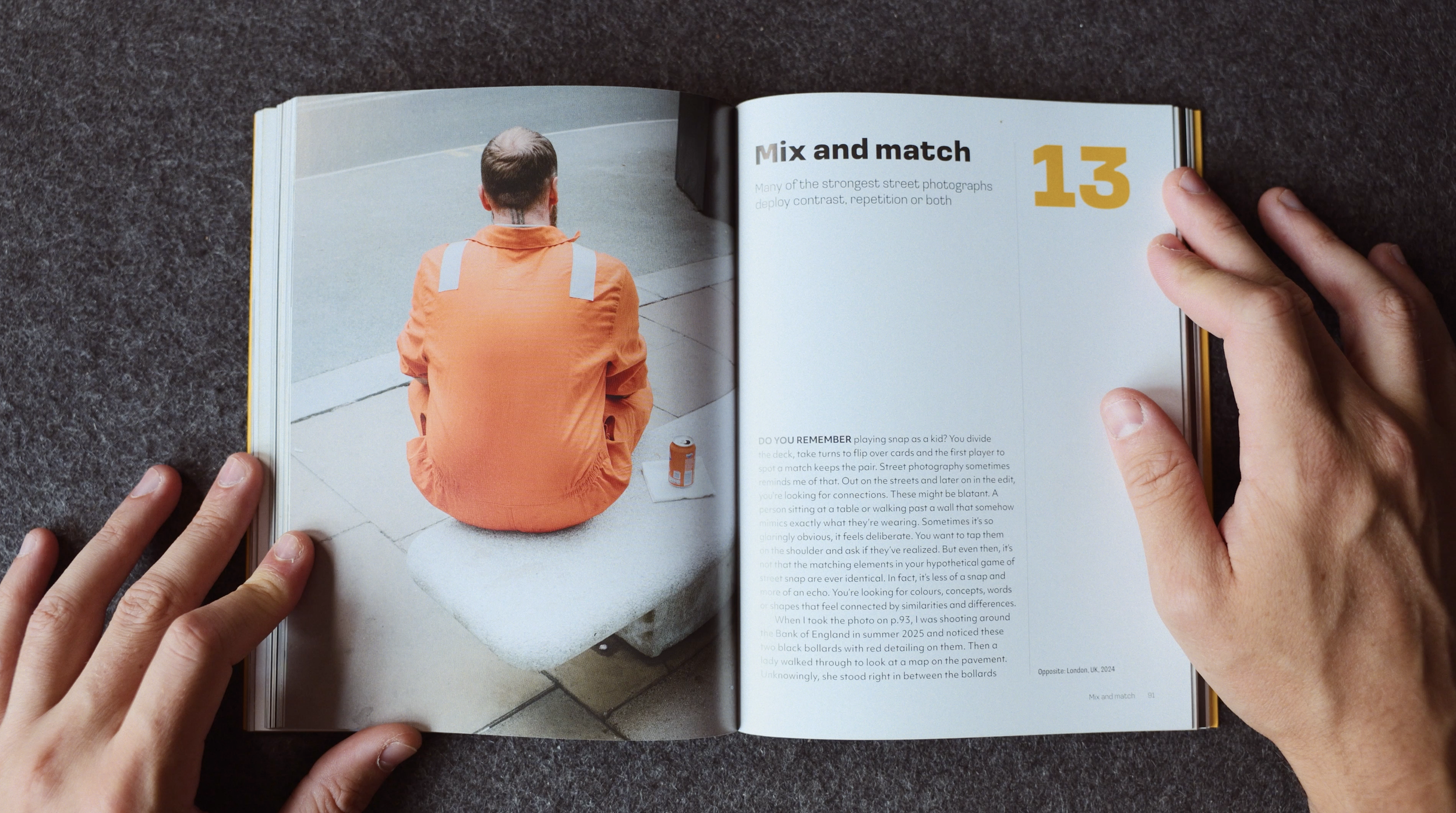
Many of the strongest street photographs deploy contrast, repetition, or both. Do you remember playing Snap as a kid? You divide the deck, take turns to flip over cards, and the first player to spot a match keeps the pair.
Street photography reminds me of that. Out on the streets, or later on in the edit, you're looking for connections. Sometimes they're blatant — a person sitting at a table or walking past a wall that mimics exactly what they're wearing. Sometimes it's so glaringly obvious it feels deliberate and you want to tap them on the shoulder and ask if they've noticed.
But the matching elements are never truly identical. It's less a game of Snap and more of an echo. You're looking for colours, concepts, words or shapes connected by their similarities and their differences.
There's a photograph on page 93 that came from exactly this. I was shooting around the Bank of England in summer 2025 and noticed two black bollards with red detailing. Then a lady walked over to look at the map on the pavement and, without knowing it, stood right between them. She was dressed all in white, with red detailing. Snap.
The scene was symmetrical and she'd stopped exactly where I wanted her. But from my eye level she wasn't in line with the posts. The connection wasn't correctly aligned — and that's entirely within my power to change. In the space of a few seconds I mentally skipped through the alternative perspectives, picked the one I wanted, and crouched down so the camera was level with her waist. Her head became the same height as the pillars, and just like that, she was part of the pattern.
I'm constantly looking for one thing that relates to another thing. Sometimes it's the contrast between them, sometimes the difference. But mostly it's Snap — spotting that the element over there connects to the element over here, and working out how to get both inside a 35mm frame.
Sometimes I see something on one side of the street and something on the other and I'd love for them to collide. Most of the time it isn't possible. But that's the game, and sometimes you see it happen right in front of you. I love that magic and I'm always looking for it.
How this book actually came about
My photographs are in it, my name is on the front, and the words are mine. But I can't take 100% of the credit.
For about six months I spoke regularly with a photography copywriter called Rachel. Niche job, I know. She essentially interviewed me on everything I think about street photography, photography generally and the creative process. Those hour-long phone calls felt like photography therapy, and I thoroughly enjoyed them. I'd brain dump every thought I had and she'd turn it into something coherent that actually made sense. If I'd been handed a blank page and told to write this from scratch, I genuinely wouldn't have known where to start.
Over the course of a year, after all that brain dumping, we went back and forth on the structure, the chapter titles, the concepts, the things that mattered to me and the things that didn't. That's how the twenty chapters came together.
The way it's been ordered, sequenced and designed is entirely down to the publishers. I contributed my two pence, suggested where the photographs should sit, and submitted the images. Everything else is them, and I'm very happy with how it turned out.
Thank you
Even if everything in this book were pure wisdom and the most intelligent thing you'd ever read — let's pretend that's true — nobody would know it existed if it weren't for you.
No publisher reaches out to some random bloke who takes street photographs unless they think it'll sell a few copies. And the only reason it'll sell a few copies is the person reading this right now.
Sometimes it's just a number on a screen, a subscriber count going up or views going up and down. But I know there are very real individuals behind those numbers, and I'm fortunate enough to meet a lot of you out on the streets or wherever I happen to be travelling. Having real conversations with real photographers who watch the videos and read this newsletter is easily the best part of it.
I don't want to get too soppy about it. When I make this stuff I'm just sharing something I'm passionate about. I can't quite believe a book has come out of it. Making something like this on my own would have been cool. That it's going to exist in your hands is much cooler, and I've got you to thank for that.
I hope some of these ideas have made you think, or made you a bit more interested in going out and shooting. Which is really the only thing left to do.
Peace.